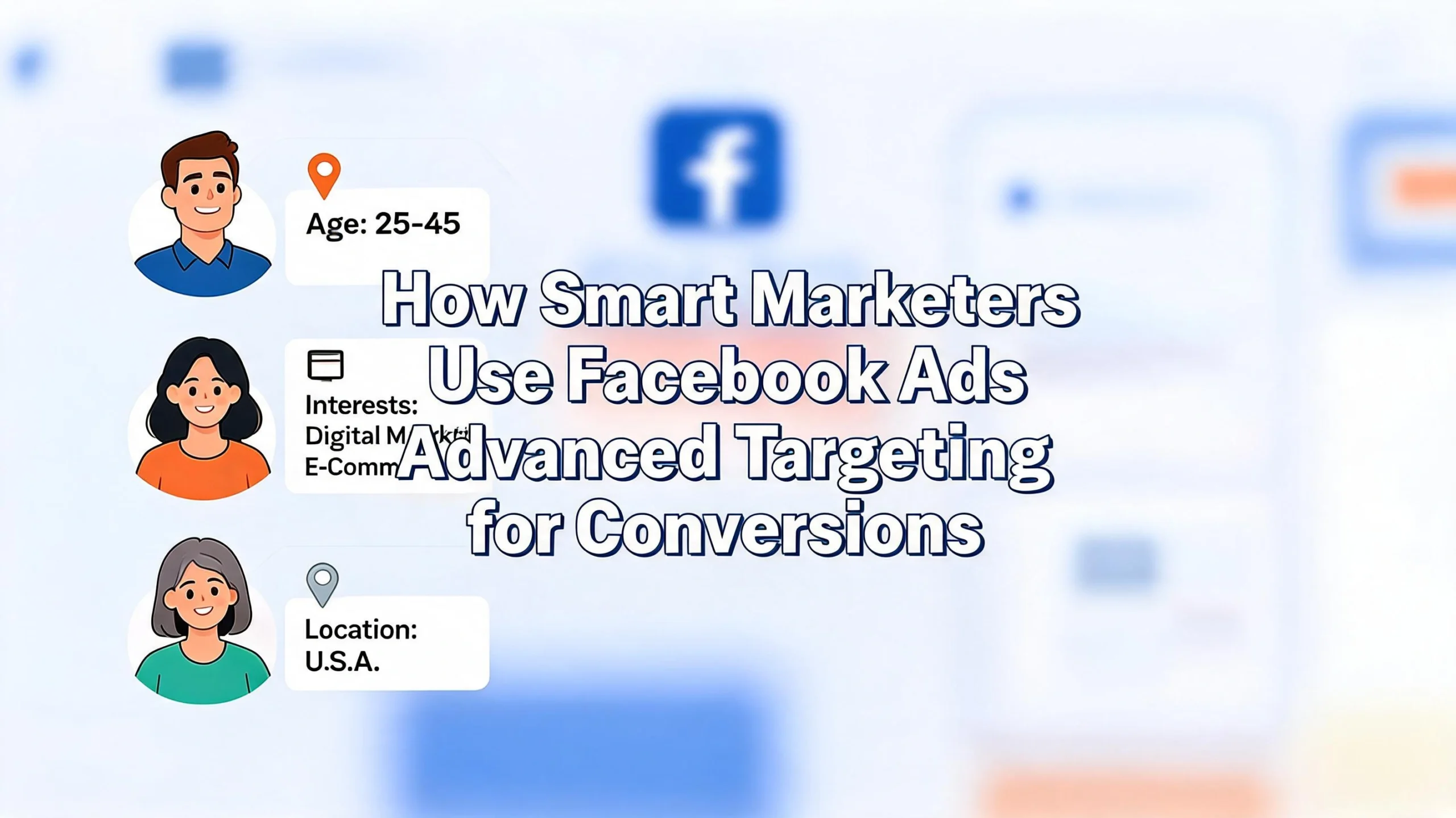
Facebook ads work best when precision meets scale. After iOS changes and higher CPMs, guesswork drains budgets fast. The fix is smarter targeting that guides Meta AI with clear signals and solid guardrails. Use first party data to teach the system who your best buyers are. Set firm rules for location, age, and exclusions. Then let Advantage Plus expand to similar people who are ready to act.
Strong inputs raise your conversion odds. CAPI restores lost events so the algorithm sees true results. Clean customer lists power value based lookalikes that find higher LTV buyers. Thoughtful exclusions cut waste. Fresh creative and dynamic formats help the system match the right message to each micro audience. Pair all of this with a simple full funnel plan and a steady testing rhythm so winners scale without chaos.
Here are the key takeaways to get you started.
Key Takeaways
-
Combine specific demographic settings with narrow interests to reach ideal buyers.
-
Exclude recent purchasers from your active ad sets to prevent wasted spend.
-
Upload clean first-party customer data to build powerful value-based lookalike audiences.
-
Pair automated Advantage+ AI expansion with clear manual rules for best results.
-
Test creative variations regularly and increase winning ad budgets by small amounts.
Master Facebook Ad Targeting with Advanced Layering Logic
Precision targeting requires active configuration in Meta Ads Manager. You must define explicit boundaries to guide Meta’s delivery algorithms toward high-intent users.
Combine Interests and Demographics
You build strong audiences by pairing granular interests with accurate demographic layers. Select specific location boundaries, age groups, and gender settings first. Then, apply conditional AND logic instead of broad OR logic.
💡 Pro Tip: Use narrow interest intersections to group high-intent buyers into clear audience segments.
When you learn how to target facebook ads effectively, you combine niche interests with exact demographics. This strategy refines your audience targeting parameters and feeds better data to Meta.
|
Advertising Metric |
Observed Drawback / Symptom |
|---|---|
|
Relevance Score |
Drops to low levels due to poor ad-audience alignment |
|
Reaches extremely poor levels despite high impression volume |
|
|
Cost Per Conversion |
Elevates significantly, revealing inefficient spending despite seemingly affordable CPC |
Eliminate Unprofitable Clicks with Exclusions
Smart advertisers protect their ad spend through strict audience exclusions. Excluding recent purchasers and disinterested visitors from Meta advertising campaigns can prevent inefficient expenditure, lowering wasted ad budget by 18% to 24%.
Apply these techniques to isolate high-value custom audiences and lookalike audiences:
-
Utilize exclusion filters on custom audiences (such as past buyers or email lists) at the ad set level to isolate target groups.
-
Replace broad umbrella categories with specific, niche interest keywords to minimize cross-targeting.
-
Dedicate individual ad sets to specific interest angles or themes for clearer tracking and distinct audience grouping.
-
Pre-screen targeted segments via the ‘Show Audience Overlap’ tool in Meta Business Manager to ensure overlapping visual percentage remains below 30%.
-
Assign customized visual assets to specific segments and actively track metric frequencies to prevent fatigue and internal bidding competition.
Avoid Broad Net Budget Waste
Uncontrolled targeting options quickly drain your budget. When you learn how to target facebook ads without constraints, you risk wasting impressions on low-intent users. Audience saturation also drives up acquisition costs:
-
Reaching an audience saturation level above 70% acts as a key indicator that an increase in CPM is imminent.
-
Narrower target audiences suffer from faster ad fatigue and inventory depletion, leading to premature CPM spikes compared to broader audiences that sustain lower CPMs over a longer duration.
To fix this, structure your facebook ad targeting using distinct buyer stages. Separate cold prospecting audiences, warm engagement groups, and lower-funnel retargeting audiences.
Applying strategic targeting options helps you maintain control over every campaign. Master these basic audience targeting options today so you know exactly how to target facebook ads for maximum return.
Utilize First-Party Data Strategies and Lookalikes
First-party data powers modern advertising strategies. You must feed Meta high-quality customer signals to optimize your campaign targeting.
Integrate Conversion Data via CAPI
Meta Conversions API connects your web server directly to Meta. This direct connection bypasses ad blockers and restores lost conversion signals. You send purchase events, offline actions, and user data back to Meta Ads Manager.
The system matches these data points with real profiles. Meta then sharpens your audience targeting. Clean signal flow expands your custom audiences automatically. You reduce budget waste and improve precision targeting across all active ad sets.
Build High-Intent Customer Match Lists
You build effective custom audiences by uploading detailed customer match files. First-party list uploads require complete user identifiers to maximize overall match rates.
|
Category |
Identifiers / Data Points |
|---|---|
|
Contact Info |
Email address, Phone number |
|
Personal Details |
First name, Last name, Gender, Date of birth |
|
Location Details |
City, State or province, Zip or postal code, Country |
|
Technical IDs |
External ID, Mobile advertiser ID |
Detailed customer data improves your overall audience quality. You reach high-converting audiences fast. You also turn these customer lists into active retargeting campaigns. Fresh buyer lists update your custom audiences regularly and boost retargeting response rates.
Scale via Value-Based Lookalikes
Standard lookalike audiences find users who resemble past website visitors. However, value-based lookalike audiences find users who mirror your highest-spending customers. You assign customer lifetime value (LTV) metrics to your source seed audience. Utilizing high-value customer seeds to target top-LTV buyers enables Meta to prioritize high-spending users, resulting in a 15% to 30% increase in return on ad spend (ROAS) relative to standard Lookalike audiences.
Meta analyzes these source custom audiences. The algorithm identifies high-value target audience segments across Meta platforms. Value-based lookalike audiences help you reach buyers who generate higher conversion values. You expand your audience scale without increasing acquisition costs. These specialized lookalike audiences drive sustainable revenue. Strong lookalike audiences ultimately transform your overall conversion strategies into a scalable growth engine.
Optimize Facebook Ads Advanced Targeting via Advantage+
Meta offers Advantage+ settings to transform your standard facebook ad targeting setup. When you learn how to target facebook ads with modern AI tools, your detailed targeting choices act as directional hints rather than strict limits. You give Meta initial parameters, and the algorithm finds high-converting prospective buyers across broad audiences.
Use Audience Parameters as AI Hints
You divide your initial targeting parameters into two distinct categories:
-
Guiding Suggestions (Hints): You feed the AI system initial audience hints through interest selections and past engagement data. The algorithm uses pixel history and user interactions to look beyond your initial custom audience and discover optimal conversion paths.
-
Hard Controls (Strict Rules): You set explicit parameters like geographic location, languages, minimum age, and custom exclusions. These strict settings serve as firm boundaries for your ad set.
Using detailed audience parameters as flexible hints improves your overall facebook ads advanced targeting strategy. Precision targeting combined with algorithm flexibility drives better ad performance.
Balance Manual Controls with AI Expansion
Advantage+ AI broadens your reach, but specific business scenarios require strict manual facebook ad targeting controls. You must know when to restrict automated audience expansion to maintain clear analytical control over target audiences.
|
Scenario |
Reason for Manual Control |
Target Focus |
|---|---|---|
|
Hyper-Local Campaigns |
AI lacks physical room to expand within tight geographic bounds. |
~10-mile radius around a store |
|
Niche B2B Audiences |
Prevents broad AI expansion away from very small addressable markets. |
Specific CRM lists (e.g., 5,000 niche executives) |
|
Dedicated Retargeting |
Keeps ad spend strictly concentrated on warm traffic without audience leakage. |
Website visitors or cart abandoners |
You protect your ad budget when you balance automated audience expansion with manual audience targeting controls. Smart advertisers select specific targeting options depending on campaign goals and funnel stages.
Optimize Creatives and Placements
You guide Meta’s delivery system by pairing tailored visual assets with automated placement options. Creative diversification helps the delivery algorithm identify unique sub-segments of your target audience automatically.
💡 Pro Tip: Use diverse creative concepts to help Advantage+ algorithms match individual ad variations with specific user groups within your broader audiences.
You master how to target facebook ads effectively when you combine dynamic creative formats with broad targeting options. Meta distributes your visual assets across automatic placements to engage warm target audiences at lower costs. You also learn how to target facebook ads by analyzing how different demographics respond to distinct visual hooks.
Modern facebook ad targeting relies heavily on strong visual messages. When you refine your core facebook ads advanced targeting structure, high-performing creatives unlock better delivery across all Meta platforms. Apply these targeting options to build responsive audiences that yield consistent conversion volume.
Implement Proven Funnel Strategies and Testing Frameworks
You must align your funnel stages to optimize your facebook ad targeting. Successful advertisers divide ad spend across top-of-funnel (TOFU), middle-of-funnel (MOFU), and bottom-of-funnel (BOFU) objectives.
Align Targeting Across Funnel Stages
You control customer acquisition costs when you deploy full-funnel strategies. Match specific ad parameters with user awareness stages.
|
Account Type / Strategy |
Top-of-Funnel (TOFU) |
Middle-of-Funnel (MOFU) |
Bottom-of-Funnel (BOFU) |
|---|---|---|---|
|
Established Brands |
60% |
20% |
20% |
|
New Accounts (Limited Pixel Data) |
70% |
Shifted later |
Shifted later |
|
Alternative Stage Guidelines |
20–30% |
20–30% |
Remaining balance |
|
Funnel Stage |
Recommended Parameters |
Intent / Reach Level |
|---|---|---|
|
Top-of-Funnel (Prospecting) |
• 1% Lookalike Audiences derived from high-value customers |
Broad reach aimed at cold prospects with high potential relevance |
|
Bottom-of-Funnel (Retargeting) |
Custom Audiences based on high-intent actions: |
Highly specific focus on warm, high-intent users to close sales |
Use strategic targeting options to reach cold prospective audiences. You build 1% lookalike audiences from high-value seeds to attract new prospective buyers. You also build custom audiences from recent website visitors to run retargeting campaigns.
Deploy the 3-2-2 Testing Framework
Systematic testing frameworks refine your facebook ad targeting over time. You learn how to target facebook ads efficiently by testing creative variables inside single ad sets.
Follow these simple steps to set up the 3-2-2 framework:
-
Asset Uploads: Load 3 media assets (images or videos), 2 unique headlines, and 2 primary text options into a Dynamic Creative setup.
-
Combination Generation: Meta automatically combines these elements into 12 distinct ad variations.
-
Budget & Duration Setup: Run the test utilizing Ad Set Budget Optimization (ABO) over a period of 7 to 14 days to ensure balanced delivery across variants.
💡 Pro Tip: Effective audience targeting relies on creative variation to find high-performing messaging for each buyer audience.
This framework improves overall conversion rates. You understand how to target facebook ads while gathering clear performance data. Modern audience targeting uses creative assets to segment your target audience groups naturally.
Scale Winning Targeting Combinations
You scale winning setups after identifying strong performance signals. Master facebook ad targeting by protecting ad set stability during budget expansion.
Keep these core guidelines in mind when scaling:
-
Increase ad set budgets conservatively by 15% to 20% every few days to avoid triggering the learning phase.
-
Deploy proven retargeting strategies to convert active audiences across bottom-of-funnel stages.
-
Launch retargeting campaigns for engaged audience segments to drive quick conversion actions.
-
Select precise targeting options to isolate high-intent custom audiences from broad audience segments.
-
Discover how to target facebook ads at scale by pairing lookalike audiences with automated delivery features to reach a warm audience.
Scaling your facebook ad targeting requires patience and disciplined testing strategies. Keep your customer audience data fresh to sustain long-term campaign profitability.
You must evolve your facebook ad targeting strategies away from broad guessing. Modern AI tools need precision targeting limits to maximize profits.
|
Audience Category |
Recommended Refresh Frequency |
|---|---|
|
Active Customer Lists & Lead Audiences |
Every 7 days |
|
Retargeting Pools & Engagement Audiences |
Every 7–14 days |
Audit your current account structure:
-
Check your ad set targeting parameters for every target audience segment and target audience group.
-
Exclude past buyer audiences from prospecting audiences to keep cold audiences separate from warm custom audiences.
-
Update source seed audiences to feed a fresh target audience profile and clear target audience signals to Meta algorithms.
Audit your full facebook ad targeting setup now! Upgrading your facebook ads advanced targeting drives predictable conversions across all active buyer audiences.
FAQ
What is facebook ads advanced targeting?
Facebook ads advanced targeting pairs first-party pixel signals with Meta AI. You discover how to target facebook ads by combining interests and exclusions. This process improves baseline facebook ad targeting. Consequently, you reach high-intent audiences and drive predictable conversion volume across active buyer audiences.
How do custom audiences improve campaign results?
| Audience Type | Core Benefit | | : | : | | Custom Audiences | Targets verified past buyers | | Lookalike Audiences | Finds high-value new users |
Uploading customer match files creates powerful custom audiences. You apply smart targeting options to isolate user groups. This precise audience targeting guides Meta algorithms toward buyers.
How do lookalike audiences support scaling strategies?
You pair source audience lists with value metrics. You learn how to target facebook ads to scale acquisition safely. These smart strategies expand your reach across broad audiences without losing targeting precision.
Why should you run retargeting campaigns alongside prospecting?
Running dedicated retargeting campaigns keeps your message focused on interested visitors. You apply specific facebook ad targeting settings to separate cold traffic from warm retargeting pools. You select flexible targeting options to show tailored ads to an engaged audience. This balanced targeting structure drives higher conversion rates.
How often should you refresh target audiences?
You must refresh active audiences every two weeks to prevent ad fatigue. Updating buyer lists provides fresh audience signals to Meta algorithms. Proper facebook ad targeting requires updating audience groups regularly. When you master how to target facebook ads, clean retargeting setups keep broad audiences engaged over time.