
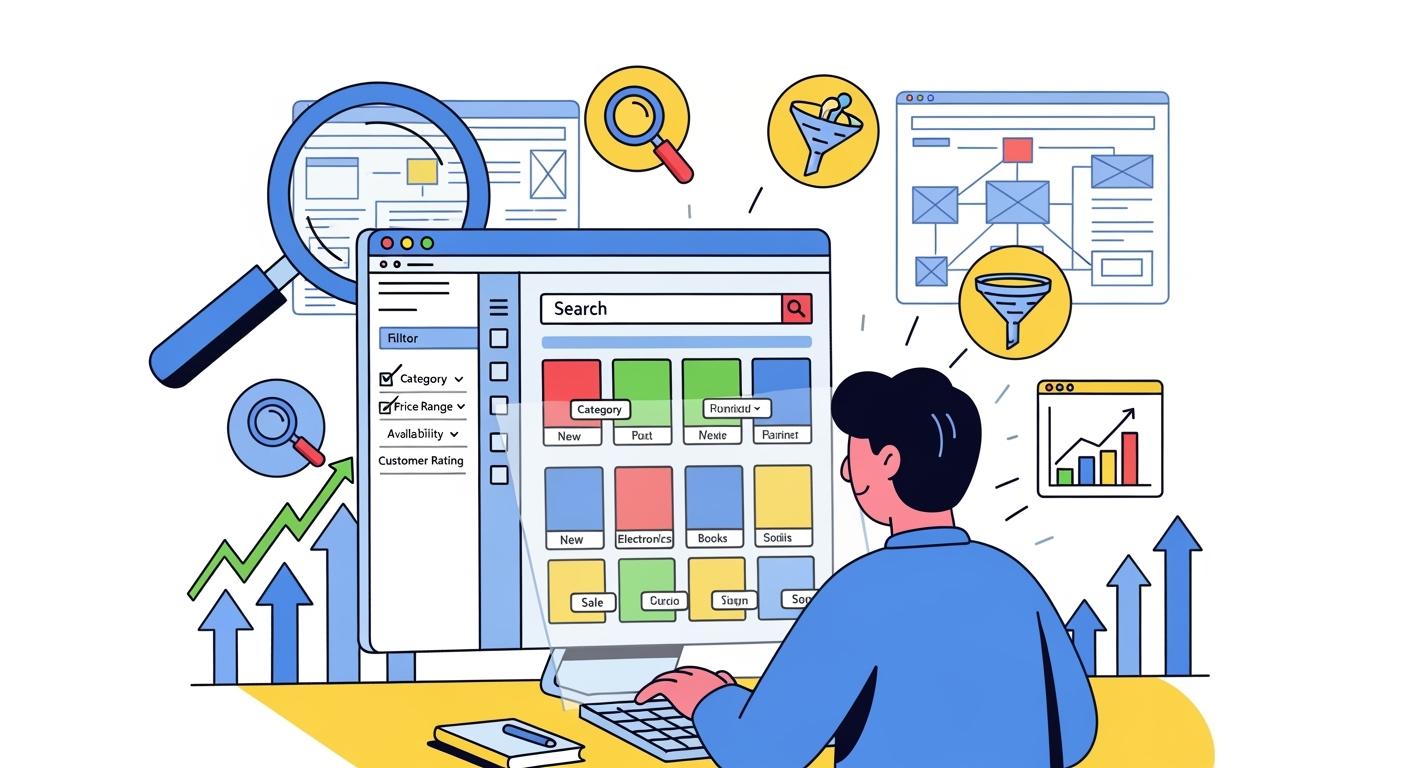
You use faceted navigation to help users filter products by color, size, or price. Faceted navigation improves site experience. It also creates faceted navigation seo challenges. You see how search engines struggle with seo on large sites. Search engines crawl many faceted navigation pages. Search engines may index too many similar pages.
Key Takeaways
-
Faceted navigation enhances user experience by allowing product filtering, but it can lead to SEO challenges like duplicate content and crawl waste.
-
Regularly audit your indexed pages to identify low-value URLs. Focus on keeping only those that drive meaningful traffic to improve your site’s SEO.
-
Use canonical tags and noindex directives to manage duplicate content and consolidate link equity, ensuring search engines prioritize your most important pages.
Faceted Navigation SEO Challenges
Faceted navigation gives you powerful tools to filter products and content. You can sort by price, color, size, or brand. This flexibility improves user experience, but it also creates several SEO challenges. You must understand what happens when you allow endless combinations of filters. These combinations can lead to crawl waste, duplicate content, and diluted link equity.
Let’s break down each challenge.
Crawl and Indexation Issues
When you use faceted navigation, you create many faceted pages. Google crawls these pages, but not all of them add value. You may see crawl waste as Google spends time on duplicate or low-value URLs. This can limit how often Google crawls your important pages. You risk index bloat when Google indexes too many similar pages. Search engines may interpret excessive URL variations as low-quality site architecture.
Modern search engines try to recognize patterns in URLs. They look for filters, sorting options, and session identifiers. If you generate too many URLs, Google may see this as manipulation and reduce your site’s visibility.
Here are common crawl and indexation issues you may face:
-
Duplicate content from multiple versions of the same URL.
-
Diluted link equity as internal links spread across many URLs.
-
Wasted crawl budget as Google crawls duplicate pages.
-
Crawl traps from endless combinations of core URLs.
-
Search engine index bloat.
Faceted navigation examples show how filters can multiply URLs. A shoe store lets you filter by color, size, and brand. You can create over 15,000 unique URLs. Each filter combination creates a new faceted page. E-commerce sites often struggle with crawl waste because Google crawls these pages instead of focusing on your main product or category pages.
Duplicate Content Risks
Duplicate content is a major concern with faceted navigation seo. You generate multiple versions of the same URL when users select different filters. For example, you may see URLs like /shoes?color=red, /shoes?color=red&size=8, and /shoes?size=8&color=red. These pages show the same products, but Google sees them as separate pages. According to Google’s guidelines, you should avoid creating duplicate content. Multiple URLs with duplicate content compete against each other for rankings.
Almost 30% of all content online is duplicate. Faceted navigation creates duplicate pages that confuse search engines. Google struggles to decide which page to rank. This lowers your visibility and can exclude your pages from search results. You must watch for duplicate content because it can hurt your organic search rankings and traffic.
Link Equity Dilution
Faceted navigation can dilute link equity across your site. When you create many faceted pages, you spread link authority thin. Google divides ranking signals among similar pages instead of focusing on your main landing pages. This reduces the authority of your key product and category pages. Diluted link equity: When link authority spreads across too many low-value URLs, your core pages suffer.
You may see link equity dilution when multiple URLs compete for the same keywords. Ranking signals split across these URLs. This self-competition confuses Google and lowers rankings for all affected pages. Imagine trying to fill one bucket with water using two hoses pointed at different buckets.
You end up with multiple half-full buckets instead of one full bucket.
Faceted navigation examples from e-commerce show how filters like price, size, and color create thousands of URLs. A fashion store lets you filter clothes by color, size, and brand. A job portal filters listings by experience level, salary, and location. A travel website filters packages by price, destination, and travel dates. Each filter combination creates new faceted pages, spreading link equity and causing crawl waste. Faceted navigation seo challenges affect your site’s crawl, index, and ranking potential.
You must understand what happens when you allow multiple versions of the same URL. You risk crawl waste, duplicate content, and diluted link equity. These issues can lower your site’s visibility and authority in search results.
Optimizing Faceted Navigation for SEO
Faceted navigation can transform your site’s usability, but you must optimize it for search engines to avoid common pitfalls. You can follow a clear process to audit, manage, and improve your faceted navigation for better SEO, higher organic search visibility, and more targeted traffic.
Auditing Indexed Pages
You start by auditing your indexed faceted pages. This step helps you understand which URLs search engines like Google have discovered and indexed. Many sites with faceted navigation see thousands of URLs in the index, but only a small percentage drive meaningful traffic from organic search.
To audit your indexed pages, follow these steps:
-
Use Google’s
site:operator to check how many faceted pages appear in the index. Compare this number to your main product and category pages. -
Review the Coverage Report in Google Search Console. Look for unexpected or low-value URLs that have been indexed.
-
Analyze your server logs to see how often Googlebot crawls faceted pages compared to high-value pages.
-
Evaluate which faceted pages receive organic search traffic. Focus on those that match real search intent and bring users to your site.
-
Identify crawl waste by comparing Googlebot activity with actual user visits. Pages that get crawled but never visited by users often waste crawl budget.
Tip: Use web analytics tools to track visitor behavior on faceted pages. If a page gets little or no traffic, consider removing it from the index.
You can also use a table to classify your faceted pages:
|
Category |
Description |
|---|---|
|
Index |
High-value pages targeting specific search queries with proven demand. |
|
NoIndex |
Pages needed for user experience but not for search results. |
|
Disallow |
Deep or nonsensical filter combinations that waste crawl resources. |
By auditing your indexed pages, you ensure that only valuable URLs appear in search results and that your site aligns with user search intent.
Managing Crawl Budget
Managing your crawl budget is essential for large sites with faceted navigation. Google allocates a limited number of crawl requests to each site. If you let Google crawl thousands of low-value faceted pages, your important product and category pages may get less attention.
You can manage crawl budget with these strategies:
-
Block non-valuable facet combinations using robots.txt. This prevents Google from crawling endless filter combinations that add no value.
-
Use canonical tags on faceted URLs to point back to the main category page. This helps consolidate link equity and avoids duplicate content.
-
Apply noindex directives to low-value or thin faceted pages. This keeps them out of the index while allowing Google to crawl them for site structure.
-
Analyze user engagement with filters. Prioritize indexing for facets that attract real traffic and match search demand.
Optimizing crawl budget improves your site’s visibility. When you direct Google to crawl high-value product pages instead of low-value faceted pages, you increase the chances of ranking for important search queries. This approach reduces crawl waste and ensures that your best content appears in organic search results.
Using Canonical Tags and Filter Strategies
Canonical tags and filter strategies play a key role in faceted navigation SEO. You use canonical tags to tell Google which version of a page should receive ranking credit. For example, if you have multiple versions of the same URL due to filters, you can point all filtered pages back to the main category page with a canonical tag. This prevents duplicate content issues and consolidates ranking signals.
You can also use filter strategies like noindex and rel=prev/next:
-
The noindex directive keeps filtered pages out of search results but allows Google to crawl them for site structure.
-
Using noindex with follow ensures that only valuable pages consume index capacity.
-
Implementing rel=prev and rel=next tags helps manage pagination, improving user experience and accessibility.
Note: Always make your decision to index faceted navigation pages based on data. Only index combinations that have high search demand and offer unique value. For low-value permutations, use noindex meta tags and canonical tags to prevent duplicate content and save crawl budget.
Creating High-Value, Search-Driven Pages
You can turn faceted navigation into an SEO advantage by creating high-value, search-driven pages. These pages target long-tail search queries and match specific user needs. To do this, you must choose the right filters and facets.
Follow these best practices:
-
Use relevant filter options for each product type, such as price, brand, or features.
-
Position facets in a way that makes sense for your users, either horizontally or vertically.
-
Present facets with user-friendly controls like checkboxes, sliders, or dropdowns.
-
Show the number of results for each filter option to guide users.
-
Allow users to filter and sort at the same time for better exploration.
-
Make it easy to remove filters and optimize for both mobile and desktop users.
You should also use search demand data to inform your filter choices. Tools like Google Trends help you identify which filters match current search interests. By analyzing keyword variations and product-related searches, you can uncover new opportunities for long-tail search queries.
Continuous optimization is important. Monitor page performance and remove underperforming faceted pages. This keeps your SEO strategy aligned with real search demand and user behavior.
Leading e-commerce sites avoid generating low-quality faceted pages by disabling parameters with no SEO value, marking parameterized URLs as non-parameterized, and adding noindex tags to filter pages that do not serve search intent. By following these steps, you can balance user experience with search engine requirements. You will drive more targeted traffic, improve organic search visibility, and avoid the common pitfalls of faceted navigation.
You need to manage faceted navigation to balance user experience and search. Faceted navigation helps users find products quickly and boosts traffic. Regular audits of faceted pages let you spot duplicate content and improve organic search results.
Ongoing review keeps your site ready for google updates and maintains strong seo performance.
FAQ
What is faceted navigation?
Faceted navigation lets you filter products or content by attributes like color, size, or price. You use it to help users find items faster.
What problems can faceted navigation cause for SEO?
Faceted navigation can create duplicate pages, waste crawl budget, and dilute link equity. You may see lower rankings if you do not manage it well.
What steps can you take to optimize faceted navigation for SEO?
-
Audit indexed pages.
-
Use canonical tags.
-
Block low-value filters.
-
Monitor search traffic.
-
Remove underperforming pages.