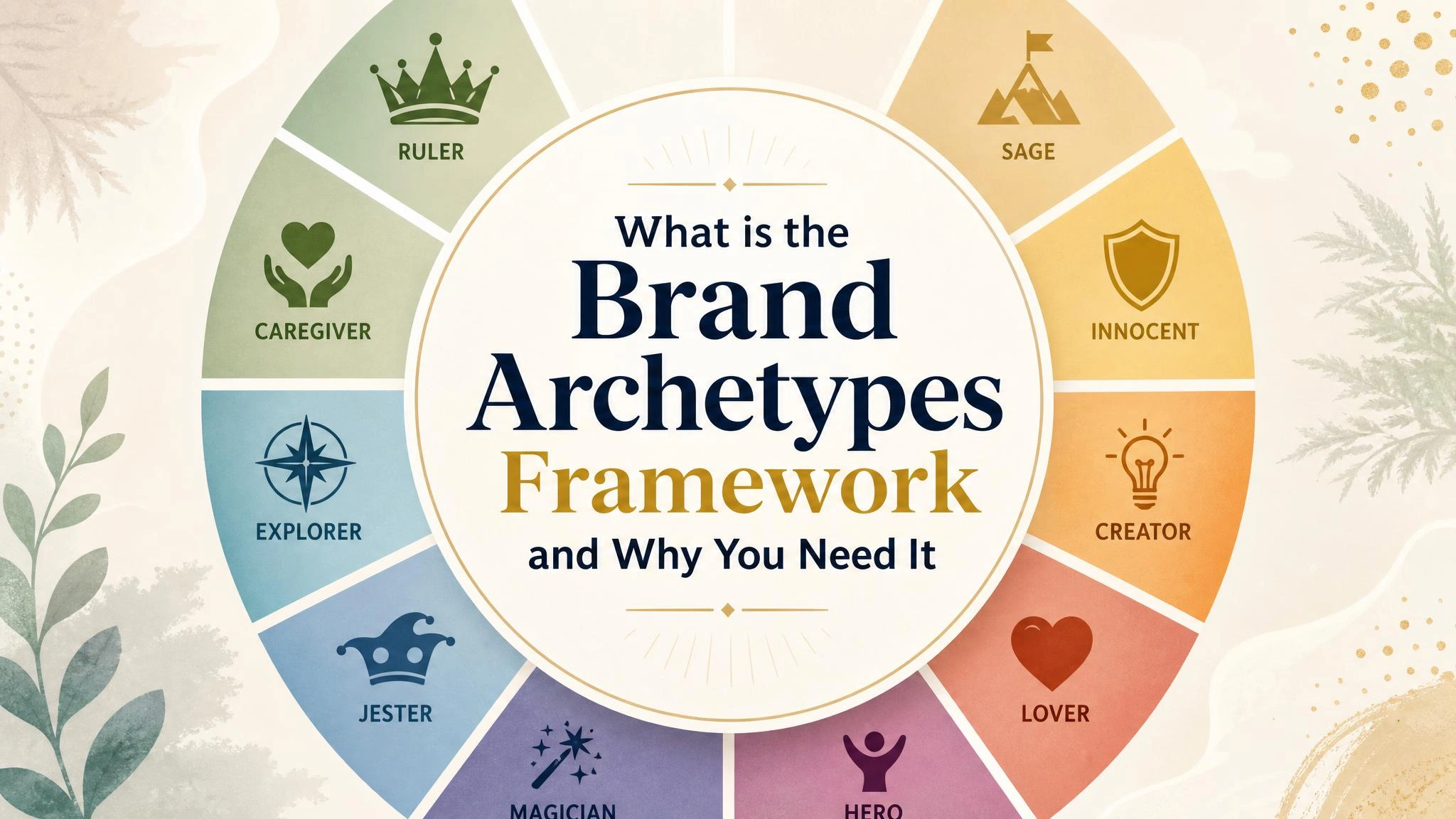
Your brand is more than a logo or a set of colors. It is a personality that people feel and remember. The brand archetypes framework gives you a simple way to define that personality using timeless human characters grounded in Jungian psychology. When you choose a clear archetype, your message becomes familiar and trustworthy. Customers recognize your intent fast and form emotional bonds that last.
This is not just theory. Archetypes help you stand out in crowded markets, keep your voice consistent across every channel, and guide daily decisions inside your company. They turn features into meaning. They turn buyers into advocates.
In this guide you will learn the 12 classic archetypes, see real examples, and get a practical process to pick and apply the right one for your business.
Ready to put a clear voice behind your brand and grow with confidence? First, here are the key takeaways.
Key Takeaways
-
Brand archetypes shape your business personality into familiar human profiles. They build strong emotional bonds and increase customer loyalty.
-
Choosing a clear archetype sets your company apart from competitors. It turns simple product features into a memorable market identity.
-
A unified archetype framework keeps your brand message consistent. Consistent communication builds long-term customer trust and grows business revenue.
12 Classic Brand Archetypes Explained
|
Consumer Behavior Metric |
Performance Impact |
Strategic Benefit |
|---|---|---|
|
Subconscious Purchasing Choices |
94% of decisions |
Leverages instant psychological recognition |
|
Customer Engagement Increase |
Up to +40% |
Strengthens emotional connection |
|
Campaign Performance |
+35% effectiveness |
Improves messaging resonance |
|
Resource Efficiency |
+30% efficiency |
Streamlines communication strategy |
These twelve brand archetypes span the entire spectrum of human desires and needs. Understanding these common personality archetypes helps you identify your ideal position in the competitive commercial landscape.
Belonging and Connection Archetypes
Social motivation centers on mutual relationships, affection, and community safety. These archetypes build meaningful bonds with your target audience through empathy, shared experiences, and genuine joy.
-
The Everyman: This profile values belonging, practicality, and humble connection. You position your company as approachable and dependable, serving everyday needs without pretension. A classic example includes IKEA for home goods, Discover for financial services, and Budweiser for social beverages.
-
The Lover: This identity focuses on passion, intimacy, and sensory pleasure. You craft an inviting narrative around emotional closeness and luxury. Godiva represents a prime example in fine chocolates, while Hallmark demonstrates this warmth in personal greeting cards.
-
The Jester: This character brings fun, humor, and lighthearted optimism to daily life. You use playful humor to break down consumer stress and spark immediate happiness.
The following core attributes define this group:
-
Connection: Focuses on establishing deep, meaningful relationships with the audience.
-
Empathy: Exhibits strong understanding and compassion for customer needs and feelings.
-
Community: Encourages a feeling of inclusion and builds shared spaces for people to unite.
-
Joy: Infuses positivity and happiness into experiences using humor, affection, or mutual interactions.
Mastery and Achievement Archetypes
Achievement-oriented personalities inspire action, risk-taking, and significant personal progress. Brands in this group help consumers overcome difficult obstacles and realize their highest potential.
|
Archetype |
Core Motivational Drives |
|
|---|---|---|
|
Hero |
• Development & Accomplishment |
Position products as tools that enable consumers to overcome difficult challenges and prove their personal worth. The consumer is cast as the hero while the brand serves as the empowering equipment. |
|
Outlaw |
• Development & Accomplishment |
Position products through a freedom-and-rebellion posture, breaking outdated norms and embracing risk to make an impact. |
The Hero archetype inspires personal strength and relentless determination. Brands like Nike and Craftsman Tools use this approach by solving painful customer problems directly. You highlight endurance and courage rather than simple product specifications.
The Outlaw archetype challenges the status quo through bold disruption and authentic self-expression. Motorcycle manufacturer Harley-Davidson provides a clear example of this rebellious posture. Red Bull also uses this freedom-focused strategy to build a devoted community around extreme performance.
The Magician archetype transforms customer lives through innovation and awe-inspiring experiences. You engage consumers by showing rapid personal growth and technological wonder.
Magician brands like Apple and Disney use specific promotional tactics:
-
Driving Personal Change: Demonstrate how your offerings bring about significant personal or professional improvement.
-
Pioneering Advanced Technology: Frame your business as a market trailblazer by spotlighting state-of-the-art developments and novel concepts.
-
Instilling Awe: Craft captivating visual content and immersive brand interactions that spark fascination and intrigue.
-
Building Emotional Resonance: Connect deeply with consumers by illustrating how creative solutions help them reach their aspirations.
-
Utilizing Transformative Narratives: Frame marketing around powerful storytelling, focusing on user evolution and visionary progress.
This thorough breakdown of brand archetypes explained demonstrates how achievement personalities turn everyday products into tools for individual transformation.
Independence and Truth Archetypes
Truth-seeking personalities center on knowledge, personal freedom, and fundamental simplicity. These identities appeal directly to consumers who value intellectual honesty and unvarnished reality.
|
Archetype |
Core Motivation |
Truth & Audience Alignment |
|---|---|---|
|
The Explorer |
Seeking a more authentic, fulfilling, and elevated life experience. |
Focuses on personal discovery and authenticity; fulfills the customer need for freedom. |
|
The Sage |
Driven to discover and uncover the truth. |
Wise and knowledgeable; deeply resonates with audiences valuing truth and intellect. Fulfills the customer need for mastery. |
|
The Innocent |
Aspires to reach and experience paradise. |
Centers on purity, simplicity, and fundamental optimism; fulfills the customer need for safety and comfort. |
The Explorer encourages self-discovery, adventure, and boundary-pushing experiences. Outdoor gear companies embody this desire for open horizons and personal liberty.
The Sage focuses entirely on wisdom, factual clarity, and intellectual rigor. In this scenario, Google serves as a famous example of this identity. Google guides its audience as a trusted digital mentor, organizing global information for universal utility.
The Innocent centers on wholesome simplicity, honesty, and safety. You reassure your audience through clean ingredients and clear promises. Having these 12 brand archetypes structured cleanly allows your business to choose the exact path toward audience trust.
Stability and Control Archetypes
Control-oriented personalities create structure, safety, and lasting excellence in an unpredictable world. These brands offer clear guidance, reliable protection, or top-tier artistic craftsmanship.
|
Archetype |
Core Characteristics & Personality |
Primary Goals & Values |
|
|---|---|---|---|
|
The Ruler |
Confident, authoritative, influential, and focused on control and leadership. |
Wants to build stability, order, and prosperity; values quality and excellence. |
Appeals to consumers seeking status, high performance, success, or an elite feel. |
|
The Caregiver |
Compassionate, empathetic, nurturing, and supportive. |
Aims to assist others, offer comfort, and protect people from harm. |
Appeals to customers looking for safety, care, and dependable service. |
|
The Creator |
Artistic, inventive, original, and imaginative. |
Strives to produce lasting, beautiful, and valuable creations; values self-expression. |
Appeals to individuals wanting to express their uniqueness and exercise creativity. |
The Ruler archetype projects absolute authority, prestige, and power. Luxury watchmaker Rolex offers a perfect example of this dominant persona. Rolex commands over twenty percent of global luxury watch sales by emphasizing extreme precision and elite accomplishment. Similarly, fashion house Louis Vuitton demonstrates this status by using rich heritage and exclusive craftsmanship to signal success.
|
Brand |
Archetype Strategy |
Operationalization & Impact |
|---|---|---|
|
Rolex |
Power & Control Narrative |
Emphasizes extreme precision, craftsmanship, and timeless design to signal personal accomplishment and leadership. Commands over 20% of global watch sales. |
|
Louis Vuitton |
High-Profile Collaborations |
Partners with renowned artists and designers to maintain exclusive positioning and project high social status. |
The Caregiver acts as a compassionate protector dedicated to customer safety and well-being. Healthcare providers and insurance providers adopt this direct, warm voice to comfort anxious consumers.
The Creator unleashes imagination to turn novel ideas into durable realities. Software tools and creative platforms leverage this mindset to empower individual expression. With these brand archetypes explained, your executive team can select the precise personality framework required for long-term commercial distinction.
Strategic Value of the Brand Archetypes Framework
Applying the brand archetypes framework grants your business a massive competitive advantage in today’s crowded digital marketplace. Modern consumers encounter thousands of promotional messages every day. Most marketing efforts fail because they focus entirely on simple product features. Feature-based communication fails to capture attention because competitors can easily copy functional benefits. The brand archetypes framework elevates your core business strategy by grounding your market presence in fundamental human psychology.
When you establish a strategic brand identity using psychological archetypes, you define a clear identity that resonates instantly with your audience. You turn abstract values into a familiar persona that customers easily recognize and trust. This alignment transforms casual buyers into devoted brand advocates.
You also streamline your strategic operations when you build your market strategy around a distinct brand personality. Your team gains a clear playbook for messaging, customer service, and visual design. Implementing brand archetypes eliminates confusion across departments, saving valuable executive time and resources.
Emotional Connection and Loyalty
You build deep customer loyalty when your communication appeals directly to human emotions. Functional benefits inform customers, but emotional triggers drive actual purchasing behavior. Aligning your business with a specific archetype allows you to trigger powerful emotional reactions in your target market.
Research published by Harvard Business Review reveals that brands capable of triggering powerful emotional reactions achieve a 306% increase in customer lifetime value compared to those that do not. You maximize your return on marketing investments by systematically building these emotional bonds. You can monitor and track the long-term impact of this emotional alignment through several vital performance metrics:
-
Customer lifetime value (LTV): Tracks the total revenue you generate from a single customer relationship over time.
-
Customer advocacy and referral generation: Measures how enthusiastically your existing clients recommend your services to prospective buyers.
-
Emotional resonance and perception metrics: Evaluates how deeply your target audience connects with your core brand message.
-
Engagement levels with marketing content: Quantifies audience interaction across social channels, email campaigns, and brand initiatives.
Market Differentiation and Positioning
Standing out in saturated markets requires more than minor product updates. Globalized markets allow competitors to clone physical features quickly. You can cut through market noise by tying your commercial offerings to a deeper organizational purpose that competitors cannot easily copy.
You achieve distinct market positioning through several structured strategies:
-
Focus on Core Motivations: Archetypal frameworks simplify your messaging down to twelve primary human drivers. This focus allows you to target fundamental audience needs without cluttering your public image with secondary details.
-
Layering Supporting Archetypes: You can stand out even if you share a primary identity with a competitor. For example, a company with a primary Creator profile can pair with an Outlaw for an edgy tone or a Sage for a research-backed tone.
-
Utilizing Sub-Archetypes: Expanding primary groups into nuanced categories provides precise differentiation. Dividing a broad identity into specific sub-categories creates clear distinction in operational style and problem-solving approaches.
-
Authentic Brand Storytelling: Combining archetypal frameworks with your unique corporate history ensures that your company presents an unforgettable market persona.
Rooting your business in a clear framework forces you to anchor your daily messaging in your foundational origin story. This clarity leaves a permanent impression on your target audience.
Multi-Channel Narrative Consistency
Modern consumers interact with your business across dozens of physical and digital touchpoints. Disjointed experiences hurt your credibility. A sudden shift from dynamic social media ads to dry, clinical landing pages creates immediate friction. Eliminating these tone disconnects stops implicit customer distrust from forming, safeguarding your conversion rates and maintaining steady revenue flow.
Using the brand archetypes framework ensures that your voice remains entirely consistent across every campaign and platform. This cross-channel alignment delivers direct financial returns across your commercial operations.
|
Metric / Mechanism |
Financial Impact & Revenue Contribution |
Source / Survey |
|---|---|---|
|
Direct Growth |
68% of organizations experience 10–20% revenue gains in Year 1 |
Industry Research |
|
Price Premium |
Enables average price premiums of 16% to 20% |
PwC / Capital One Shopping |
|
Acquisition & LTV |
Lowers CAC by 60% and raises LTV by 40% (up to 2.5x for loyalty members) |
GetResponse / Omnisend |
|
Conversion & Retention |
Yields 5–10% conversion boosts and avoids churn driven by inconsistent experiences |
PwC / Research Data |
Establishing a unified voice protects your marketing investments and boosts overall campaign performance. You eliminate redundant messaging costs while maximizing audience retention.
Internal Alignment and Corporate Culture
The benefits of selecting a brand personality extend far beyond external promotional campaigns. Your chosen profile serves as an internal compass for company culture, employee onboarding, and product design. Adopting a shared profile equips your team with a unified internal language that simplifies daily decision-making and interdepartmental collaboration.
For example, when leadership defines an explicit archetype, employees gain clarity on how to handle customer interactions and resolve daily operational challenges. This strategic framework unifies team performance across all departments.
Your business gains several key organizational benefits by adopting this internal model:
-
Behavioral Framework: Offers clear standards that orient staff members’ thoughts, core beliefs, and day-to-day actions.
-
Guiding Vision: Functions as a unified reference point across all departments to ensure complete operational consistency.
-
Distributed Responsibility: Empowers staff to take ownership of brand standards, reducing reliance on centralized executive enforcement.
-
Fulfillment Alignment: Bridges your corporate mission with core psychological drivers of job satisfaction, such as autonomy, mastery, and purpose.
Implementing archetypes aligns your internal workforce with your external promises. This strategic harmony drives authentic execution across every aspect of your business.
How to Apply Brand Archetypes to Your Business
Applying brand archetypes to your organization requires a clear execution blueprint. You turn abstract character concepts into concrete commercial results when you follow a structured brand archetype process.
Auditing Audience and Business Values
You must assess your core business positioning and existing customer perceptions before choosing a profile. Collect client feedback and evaluate your internal values. This operational step highlights the gap between your current perception and your ideal brand identity.
-
Clarify your positioning, target customer segments, and business goals.
-
Evaluate existing social sentiment and customer feedback.
-
Compare actual market perceptions against your desired character.
Selecting Primary and Secondary Archetypes
You build a strong brand personality when you focus on a single primary framework. You can add a secondary framework to create nuance without causing confusion.
-
Primary Archetype (70%): Anchors your authentic foundational purpose.
-
Secondary Archetype (20%): Adds depth and sets specific boundary rules.
-
Optional Third Archetype (10%): Offers minor tonal variation across special campaigns.
|
Brand |
Archetype Combination Strategy |
Ego-State Mix |
|---|---|---|
|
Amazon |
Combines complementary profiles within the same group |
Child Ego-State |
|
Gucci |
Blends complementary traits from the same framework |
Adult Ego-State |
|
Apple |
Integrates dual personalities sharing one psychological driver |
Parent Ego-State |
A retailer provides a great example when combining a primary Ruler profile with a secondary Caregiver profile.
Defining Brand Voice and Guardrails
Your marketing teams require clear documentation to maintain vocal consistency across channels. Standardize your message by establishing written guardrails:
-
Core Brand Voice Definition: Fix your brand personality using exact adjectives.
-
Tone Adaptation Rules: Set limits for sensitive situations.
-
Core Message Statements: Outline key brand promises for every marketing campaign.
-
Prohibited Vocabulary List: List forbidden jargon to protect your image.
Avoiding Common Execution Pitfalls
Businesses often blunder during implementation. Review these common pitfalls to protect your marketing investments.
|
Common Mistake |
Description / Cause |
Negative Impact |
|---|---|---|
|
Adopting Multiple Profiles |
Selecting several personalities simultaneously. |
Dilutes your core message. |
|
Ignoring the Shadow |
Forgetting inherent negative traits. |
Leaves your business vulnerable to PR traps. |
|
Falling into Clichés |
Relying on generic imagery. |
Results in a shallow market presence. |
Avoid using your profile as a rigid constraint. Harley-Davidson offers a famous example by using the Outlaw archetype to empower consumers rather than restricting product innovation.
The brand archetypes framework transforms your abstract company values into a distinct, humanized market presence. You turn static corporate principles into relatable personalities using universal archetypes. This strategic alignment boosts audience trust and secures long-term market differentiation.
Archetypal positioning converts brand principles into measurable valuation. This process embeds core operational variables into an Archetypal Alignment Coefficient (δ). This coefficient serves as a direct multiplier for your market impact. Aligning with human decision drivers expands customer lifetime value, accelerates acquisition, and elevates pricing power.
You gain tangible strategic advantages across every operational metric when you align your business identity with timeless psychological drivers.
|
Financial Metric / Benefit |
Business Impact of Archetypal Branding |
|---|---|
|
Customer Acquisition Cost (CAC) |
Drops noticeably because emotionally grounded creatives capture attention faster and foster quick purchasing decisions. |
|
Sales Growth |
Drives measurable revenue increases, demonstrated by Coca-Cola selling over 150 million customized units during a single campaign. |
|
Customer Retention & Loyalty |
Establishes durable emotional connections and brand familiarity, keeping consumers engaged over the long term. |
|
Market Expansion |
Pulls in new consumer segments by aligning with universal human values and themes. |
Implementing the brand archetypes framework grants you a lasting strategic advantage in modern marketing. You maximize overall returns while building deep connections with your target audience. Identify your core archetype today and express your voice consistently across every customer touchpoint.
FAQ
How do you choose the right framework for your business?
You analyze your core corporate values and audience desires. For example, your team can review customer feedback to select a primary brand profile.
Can your strategy combine multiple profiles?
Yes, you can pair a primary identity with a secondary supporting trait. This combination sharpens your marketing campaigns while preserving core brand clarity.
Why do archetypes improve audience engagement?
They tap into universal psychological patterns. Nike offers a classic example by empowering athletes, instantly driving strong emotional connection and recognition.