
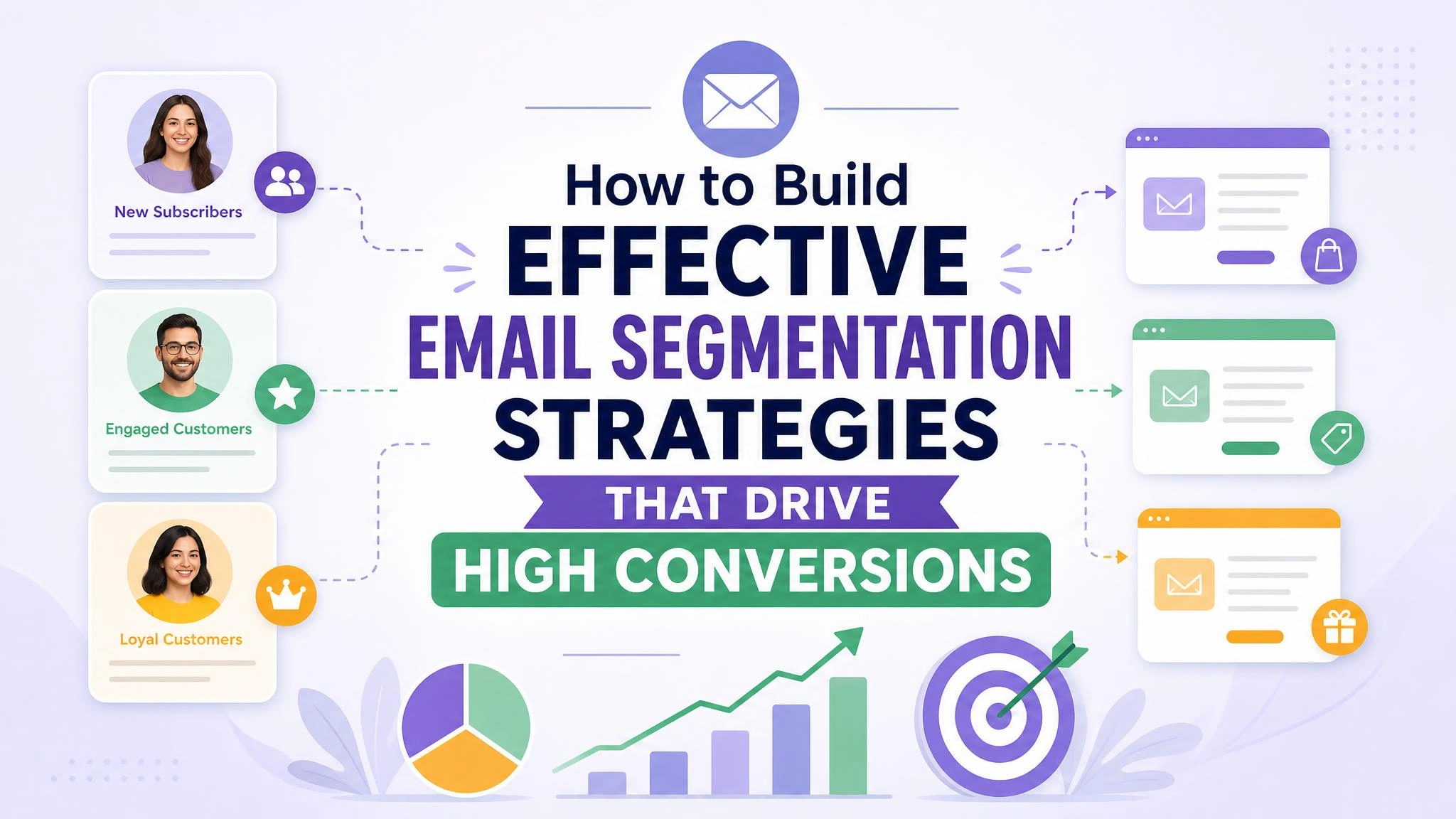
Crowded inboxes punish generic blasts. If you want consistent conversions, you need messages that match what each subscriber cares about right now. That is where smart email segmentation shines. Instead of one list for everyone, you group people by behavior, lifecycle stage, and real-time intent. The result is better deliverability, higher opens and clicks, stronger loyalty, and more revenue from the same list.
In this guide you will learn the core data layers to segment with confidence, how to clean and unify your subscriber records, and the automation rules that keep segments updated without extra work. You will also see proven triggers like welcome flows and cart recovery, plus a simple schedule to review and improve your segments over time.
Before we jump in, here are the key takeaways you can use right away.
Key Takeaways
-
Group subscribers by actions and interests to send personalized messages that build customer loyalty.
-
Target active readers with relevant emails to improve open rates and protect your domain reputation.
-
Send automatic welcome and cart recovery emails quickly to convert interested buyers and boost sales.
-
Clean your subscriber list regularly to remove dead contacts and improve email delivery success.
-
Test different send times and content monthly to continuously improve your email campaign results.
Strategic Benefits of Email Segmentation Strategies
Targeted messaging transforms simple promotional broadcasts into powerful conversion engines. Implementing precise email segmentation strategies empowers marketing teams to deliver contextually relevant messages to exact audience groups.
Elevating Deliverability and Placement
Internet service providers evaluate sender reputation using subscriber engagement. Modern segmentation separates active recipients from unengaged contacts. Marketers protect domain health by sending tailored content to interested users. This strategic approach keeps spam complaint rates low and ensures optimal primary inbox placement.
Boosting Open and Click-Through Rates
Relevant subject lines and tailored body copy consistently drive superior interaction levels across email campaigns. Audience segmentation directly elevates essential performance metrics:
|
Email Metric |
Segmented vs. Unsegmented Increase |
|---|---|
|
Open Rate |
14.32% higher |
|
Click-Through Rate (CTR) |
100.95% higher |
|
Total Clicks |
50% more clicks |
Reducing Unsubscribes and Spam Complaints
Generic message blasts trigger rapid list fatigue. Consumers ignore irrelevant promotions and frequently click the spam button. However, granular behavioral segmentation aligns message timing with buyer interest. Marketers retain valuable contacts by sending specific offers matched to individual shopping intent.
Maximizing Customer Lifetime Value
Dynamic email segmentation accelerates business revenue growth by strengthening long-term customer relationships. Delivering personalized touchpoints boosts customer lifetime value (CLV) through targeted retention workflows:
|
Customer Segment Tier |
Strategic Segmentation Approach |
Impact on Retention & CLV |
|---|---|---|
|
High-CLV Tier |
Provide VIP perks, private sales, and exclusive rewards. |
Strengthens brand equity and maximizes repeat retention. |
|
Mid-CLV Tier |
Deploy cross-selling triggers and loyalty program invites. |
Nurtures steady buyers into long-term brand champions. |
|
At-Risk Tier |
Launch win-back workflows and feedback requests. |
Re-activates dormant users to prevent churn. |
Executing refined segmentation strategies helps e-commerce brands lower customer acquisition costs while driving consistent repeat sales.
Core Framework for Email Segmentation
High-performing marketers build email segmentation around unified customer data points. Effective segmentation strategies combine multiple audience inputs to craft tailored sub-groups. Brands organize subscriber data across five essential layers to build a reliable segmentation engine.
Marketers gather five primary data categories to feed this email segmentation system:
|
Data Category |
Description |
Examples |
|---|---|---|
|
Behavioral Data |
Observable and recent actions taken on emails, websites, or products. |
Open/click history, purchases, abandoned carts, pricing page views. |
|
Declared Data |
Explicit, self-reported information provided directly by users. |
Job title, company size, location, preferred content, and email frequency. |
|
Inferred Data |
Calculated insights derived from engagement patterns or system logic. |
Activity status (active vs. dormant), loyalty tiers, lead scores, LTV predictions. |
|
Lookalike & Modeled Data |
Predictive audience profiles generated by machine learning or AI models. |
Audience conversion similarity, high-value customer traits, engagement clusters. |
|
Operational / Internal Flags |
System-level status markers and internal team tags. |
MQL status, trial/subscription renewal dates, current plan tier (Free vs. Pro). |
Demographic and Geographic Layer
Demographic traits establish the baseline layer of audience categorization. Marketers group subscribers by age, gender, job title, and industry. Geographic tags help brands localize message delivery based on physical time zones, regional climates, and local currency formats.
Static demographic details become far more powerful when combined with customer behavior observations. Combining explicit user attributes with past purchase choices allows brands to craft precise offers. This fundamental segmentation step ensures that basic subscriber profiles receive appropriate product collections.
Engagement and Activity Layer
Tracking subscriber interaction provides continuous insight into reader interest. Marketers apply behavioral segmentation to separate active readers from dormant contacts. Evaluation windows for subscriber inactivity range from 30 days to over 90 days. Send frequency directly impacts these timing parameters:
-
Higher frequency schedules require shorter inactivity windows around 60 days.
-
Lower frequency schedules utilize longer evaluation windows up to 90 days.
-
Subscribers with zero engagement across 90 days require re-engagement workflows.
The table below outlines common criteria for sorting subscribers by activity level:
|
Subscriber Status |
Send Frequency Context |
Engagement Criteria Threshold |
|---|---|---|
|
Active / Engaged |
Monthly Sends (12/year) |
Opened ≥ 1 email in the last 3 months |
|
Active / Engaged |
General Segment Parameter |
Opened ≥ 3 emails AND clicked ≥ 1 email in the last 90 days |
|
Unengaged |
Bi-weekly Sends (2/week) |
Opened only 1 email across a 3-month span |
|
Inactive |
Any Frequency |
Zero opens or clicks over an extended period or all-time |
Tracking engagement helps brands maintain healthy sender reputations. Marketers protect overall email health by routing low-engagement segments toward re-activation streams.
Lifecycle Stage and Onboarding Status
Subscribers require different messaging depending on their current buyer journey. New subscribers benefit from structured onboarding sequences. Initial welcome campaigns achieve average open rates of 83.63%. Brands capitalize on this momentum by delivering value-driven messaging immediately:
-
Welcome Sequence Structure: Deploy a 4–6 email series to deliver promised sign-up incentives, share brand values, set expectations, and guide users toward initial actions.
-
Setup Guides and Tutorials: Provide structured setup instructions and feature walk-throughs to accelerate product adoption.
-
Best Practices: Send actionable tips that assist subscribers in realizing value early.
-
Contextual Reminders: Automatically trigger targeted nudges when users bypass critical steps like profile completion.
-
Milestone Celebrations: Encourage users visually with progress tracking features as they complete initial setup tasks.
Proper lifecycle segmentation moves leads smoothly toward their initial purchase. Strategic onboarding workflows build strong early habits.
Abandoned Cart and Real-Time Intent
Real-time actions signal high immediate purchase intent. Cart abandonment workflows capture lost sales by sending targeted follow-ups. A structured 3-part recovery sequence delivers optimal revenue recovery:
|
Sequence Step |
Ideal Timing Interval |
Strategic Objective & Impact |
|---|---|---|
|
1st Email |
Within 1 hour (60 mins) |
Prompt, helpful non-pushy reminder; boosts conversion rates up to 20%. |
|
2nd Email |
24 hours (1 day) |
Follow-up targeting non-respondents; introduces extra incentives like discounts or free delivery. |
|
3rd Email |
48–72 hours (2–3 days) |
Final recovery attempt; utilizes stronger incentives or time-sensitive promotions. |
Key elements of a high-converting cart recovery framework include:
-
A 3-email drip sequence prevents missed revenue opportunities compared to shorter approaches.
-
Follow-up messages (emails #2 and #3) generate over half of total recovery campaign earnings.
-
A timed 3-part campaign schedule helps brands achieve peak recovery conversion rates exceeding 32%.
Brands also adjust messaging instantly based on live web actions:
|
High-Intent Behavioral Signal |
Triggered Dynamic Email Adjustment |
|---|---|
|
Repeat Product Views & Dwell Time |
Populates modules with recently viewed items, dynamic recommendations, and real-time ratings/reviews. |
|
Category Exploration |
Displays targeted category updates, relevant discounts, and tailored product recommendations. |
|
High-Intent Search Queries |
Customizes messaging and subject lines to match recent search terms like brand, product type, or size. |
|
Browse Abandonment |
Triggers open-time dynamic content showing active stock levels, price changes, and nearby store proximity. |
Real-time decisioning engines evaluate web behavior milliseconds before message dispatch. The system stitches together browser events, inventory databases, and promo tools. Open-time updates prevent shoppers from seeing out-of-stock items or outdated prices. Dynamic triggers match messages directly to active shopper intent.
Predictive Analytics and Churn Risk
Advanced platforms use predictive analytics to anticipate future subscriber behavior. Machine learning models analyze historical transactions, buying cadence, and engagement metrics to score accounts automatically:
|
Category |
Machine Learning Model / Metric |
Warning Signal / Context |
|---|---|---|
|
Algorithmic Models |
Logistic Regression, Random Forest, Gradient Boosting |
Applied to predict subscriber churn risk. |
|
Engagement Metrics |
Declining Open Rate |
Gradual decrease over a 4 to 8 week period. |
|
Engagement Metrics |
Cessation of Clicks |
Subscriber previously clicked but stopped interacting. |
|
Engagement Metrics |
Email Interaction Speed & Depth |
Increased unread time, reduced scroll depth, and lower click density. |
Predictive systems evaluate Customer Lifetime Value (CLV) using historical order counts, purchase intervals, and transaction recency. Machine learning text models analyze subscriber interaction patterns to flag retention risks before unsubscribes happen.
AI engines also identify candidates for cross-sell campaigns and high-value upgrades through specialized segmentation models:
|
Segmentation / Algorithmic Method |
Candidate Identification Criteria |
Strategic Campaign Application |
|---|---|---|
|
SQL Bucket & Spend Analysis |
Categorizes users by historical spend combined with recency and frequency metrics. |
Routes high-value segments toward premium upgrades and mid-tier spenders toward product bundles. |
|
Product Affinity Analysis |
Identifies items featuring co-purchase lift ratios higher than 3x. |
Forms the core basis for automated complementary cross-sell recommendations. |
|
Sequential Purchase Patterns |
Evaluates specific order paths taken following an initial purchase. |
Triggers timed post-purchase journey messages and targeted progression paths. |
|
Collaborative Filtering |
Matches buyers with similar transaction profiles to recommend peer purchases. |
Automates cross-selling based on shared preferences across buyer cohorts. |
Predictive segmentation enables proactive outreach. Brands protect revenue and boost lifetime value by targeting customer needs ahead of time.
Auditing and Cleaning Subscriber Data
Marketers must audit audience databases before launching targeted messaging workflows. Auditing data strengthens every advanced audience segmentation framework. Corrupted records undermine strategy performance and skew analytics. Effective record cleaning prevents errors during future segmentation triggers.
Evaluating Current Data Quality
Key performance metrics highlight underlying data quality problems:
-
High percentage of duplicate customer, lead, or account entries.
-
Low proportion of complete profiles missing mandatory fields.
-
Decreased address accuracy and high bounce rates.
-
High proportion of untouched records over 12 to 18 months.
Systematic list hygiene protects sender reputation. Growth teams purge dead contacts using precise criteria:
|
Target Category |
Identification Indicators |
Cleaning & Removal Action |
|---|---|---|
|
Hard Bounces |
Non-existent mailboxes or severe syntax errors |
Remove immediately after a single failure |
|
Soft Bounces |
Temporary delivery issues like server errors |
Purge after 3–5 consecutive delivery failures |
|
Unengaged Contacts |
Lack of opens or clicks within a set window |
Run win-back campaigns or drop entirely |
|
Invalid Syntax / Typos |
Domain misspellings or disposable patterns |
Instant removal during cleaning stage |
Real-time API validation filters out bad entry points automatically before corrupt data enters system pipelines.
Consolidating Multi-Channel Data
Centralizing customer touchpoints creates a complete subscriber overview. Unified profiles form the backbone of dynamic behavioral segmentation. Platform integration connects website interactions, sales histories, and campaign responses.
Customer Data Platforms unify disconnected channels through three structured steps:
-
Data Collection: Systems continuously ingest customer interactions across websites, mobile apps, and offline tools using APIs and webhooks.
-
Identity Resolution: Algorithms match exact identifiers like email addresses to connect anonymous browsing with known profiles.
-
Profile Unification: Centralized databases assemble matched data points into dynamic customer profiles for real-time activation.
Clean centralized records support reliable audience list segmentation across channels.
Establishing Standard Tagging Rules
Clear organization rules maintain database health over time. Marketing leaders enforce uniform naming conventions across custom fields, user actions, and source channels. Marketers utilize standardized tags to simplify complex segmentation logic.
Standardized field tags allow automated engines to execute accurate messaging rules. Teams streamline audience categorization by applying basic standards:
-
Structure tags using consistent lowercase formats and clear category prefixes.
-
Update subscriber attributes dynamically based on recent interactions.
-
Eliminate redundant field labels to maintain system speed.
Structured database hygiene strengthens campaign precision and maximizes segmentation outcomes across mature operations.
Implementing Automated Segmentation Triggers
Growth teams execute advanced email segmentation strategies to guide prospects through conversion pathways smoothly. Automated workflows trigger relevant communication without manual oversight.
Mapping Segments to Funnel Stages
Effective email segmentation aligns user intent with automated message workflows. Marketers implement specific segmentation strategies across distinct acquisition levels:
-
Top-of-Funnel: Automation platforms send educational guides to new leads.
-
Middle-of-Funnel: Systems target active prospects with product comparisons based on browsing behavior.
-
Bottom-of-Funnel: Automated sequences deliver personalized incentives to cart abandoners.
Proper audience segmentation improves lead movement across every sales stage.
Setting Up Dynamic Automation Rules
Marketing platforms use direct conditional logic to group subscribers continuously. Dynamic rules route contacts based on real-time behavior automatically. Systems alter list parameters when user behavior shifts. For example, recent purchase behavior updates profile attributes immediately. Automated segmentation places users into active campaigns while removing them from past workflows. Advanced email automation increases engagement through precise timing.
Continuous Segment Optimization
Continuous behavioral segmentation maximizes ROI. Marketers must practice variable isolation by executing controlled experiments that adjust only a single element at a time—such as send time, email frequency, or segment criteria—to accurately assess its specific performance impact.
-
Implement Segment-Specific Testing: Test variables across distinct subscriber segments rather than applying broad assumptions, as different audiences respond uniquely.
-
Maintain a Continuous Retesting Schedule: Re-evaluate winning variations every 3 to 6 months to combat audience fatigue and adapt to changing subscriber preferences.
-
Utilize Multivariate Testing for Large Lists: For lists exceeding 50,000 active subscribers, run multivariate tests to analyze how multiple variables interact simultaneously.
-
Log and Document All Tests: Maintain a comprehensive testing log detailing hypotheses, variables, audience segments, sample sizes, metrics, and external factors to preserve program knowledge.
Sophisticated segmentation drives campaign relevance over extended operational cycles. Teams evaluate audience rules on a structured schedule:
|
Review Frequency |
Focus Area / Action Items |
|---|---|
|
Monthly Basis |
Monitor performance metrics including enrollment volume trends, engagement rate changes, conversion performance shifts, and data quality issues. |
|
Quarterly Basis |
Conduct comprehensive audits evaluating segment relevance to business goals, criteria accuracy based on customer behavior, segment consolidation, and new data opportunities. Retire underperforming segments and merge overlapping ones. |
The core mechanics of segmentation rely on clean data structures. Regular segmentation checks prevent message delivery failures. Tailored email segmentation builds customer trust over time. Dynamic audience segmentation boosts sales consistently across all customer groups.
Modern growth leaders replace generic broadcasting with dynamic behavioral segmentation. Tailoring email messages to customer behavior boosts deliverability, conversions, and long-term loyalty. Executing refined email segmentation strategies consistently yields superior ROI over unsegmented broadcasts:
|
Segmentation Metric |
Performance Lift / ROI Impact |
|---|---|
|
Revenue Generation vs. Broadcast Sends |
+760% higher revenue |
|
Conversion Rate for Micro-Audiences |
3.4x higher conversion rate |
Effective email segmentation transforms standard marketing into personal shopping experiences. Marketers must audit database records today. Growth teams should deploy at least one real-time behavioral segmentation trigger immediately to capture lost conversions.
FAQ
How often should marketers update subscriber segments?
Automation platforms update dynamic lists in real time based on subscriber actions. Marketing teams should audit custom audience rules monthly. Quarterly reviews help growth leaders eliminate redundant criteria and maintain data accuracy across all campaigns.
What is the most effective behavioral trigger for immediate conversions?
Cart abandonment triggers generate the highest quick conversions. Sending a three-part recovery sequence within sixty minutes of abandonment captures lost buyer intent and restores potential sales effectively.
How does email segmentation improve overall inbox deliverability?
Internet service providers track subscriber engagement metrics continuously. Precise segmentation filters out dormant contacts. Sending relevant messages to active subscribers decreases spam complaints, increases open rates, and protects the primary domain reputation.
Can small businesses implement audience workflows with basic tools?
Yes. Modern email service providers include built-in conditional rules. Small teams start by organizing contacts using simple criteria:
-
Past purchase history
-
Recent link clicks
-
Sign-up source tags
This foundational segmentation approach increases revenue without requiring complex marketing platforms.